





Associate Degree of VFX and Virtual Production
EMBRACE THE LATEST TECHNOLOGIES TO ENGINEER THE IMPOSSIBLE
Online Delivery (Domestic students only)
Built for independent learners who need maximum flexibility without compromising on engagement.
- 2 hours of live online classes plus 1 hour of national content each week.
- Fully virtual with interactive sessions, discussions, and expert support.
- Access SAE’s full suite of digital learning resources from anywhere.
On Campus
Ideal for students who thrive in a face-to-face environment with access to studios, peers, and in-person support.
- Includes 2 hours of weekly on-campus classes plus 1 hour of national content (online or asynchronous).
- Classes run Monday to Friday, morning, afternoon, and evening, with access to digital resources and support.
- Perfect for hands-on learning, collaboration, and real-time feedback.
Blended Delivery
Designed for those who want the best of both worlds, structured face-to-face learning with online flexibility.
- Combines 2 hours of live (on-campus or online) classes with 1 hour of national content each week.
- Balances in-person connection with the convenience of remote access.
- Supported by SAE’s online learning tools and self-directed study resources.
National Expertise
No matter how you study, you’ll learn from SAE’s national team of expert, industry-aligned faculty.
- Access top educators and specialists across Australia, wherever they’re based.
- Benefit from national masterclasses, guest lectures, and collaborative learning.
- Tap into deep industry knowledge that goes beyond your local campus.
Units x Costs ($AUD)
16 x $2,999
Annual Course Fee (Indicative)*
(based on 1.0 EFTSL**)
$23,992 AUD
Plus Student Services and Amenities Fee (SSAF)
* The Annual Course Fee (Indicative) is charged against individual units of study which may increase from time to time and does not take into account personal circumstances such as RPL, credit, repeats and some specialised electives.
** EFTSL (Equivalent Full-Time Student Load) is a measure of a full-time student’s study load for a year. A full-time study load equates to 1.0 EFTSL. Typically, a full-time study load at SAE is 8 units of study over the year, each with an EFTSL value of 0.125.
For more information view the SAE Fee Schedule or visit the Fees & Payment page.
Units x Costs ($AUD)
16 x $3,495
Annual Course Fee (Indicative)*
(based on 1.0 EFTSL**)
$27,960 AUD
Plus Student Services and Amenities Fee (SSAF)
* The Annual Course Fee (Indicative) is charged against individual units of study which may increase from time to time and does not take into account personal circumstances such as RPL, credit, repeats and some specialised electives.
** EFTSL (Equivalent Full-Time Student Load) is a measure of a full-time student’s study load for a year. A full-time study load equates to 1.0 EFTSL. Typically, a full-time study load at SAE is 8 units of study over the year, each with an EFTSL value of 0.125.
For more information view the SAE Fee Schedule or visit the Fees & Payment page.
Complete your course faster by studying units over 15 months (4 trimesters).
Complete your course faster by studying units over 15 months (4 trimesters).
Whilst still classified as a full-time study load, you will complete the units over two years (6 trimesters).
May 2026
September 2026
February 2027
May 2026
February 2027
Your creative career starts with SAE
Course Structure
The Associate Degree of VFX and Virtual Production is broken up into two distinct stages, each designed to develop different skills. This course allows you to choose from a pool of electives throughout your studies and will see you develop a specialisation in one of three areas: Virtual Production, VFX and Technical Art.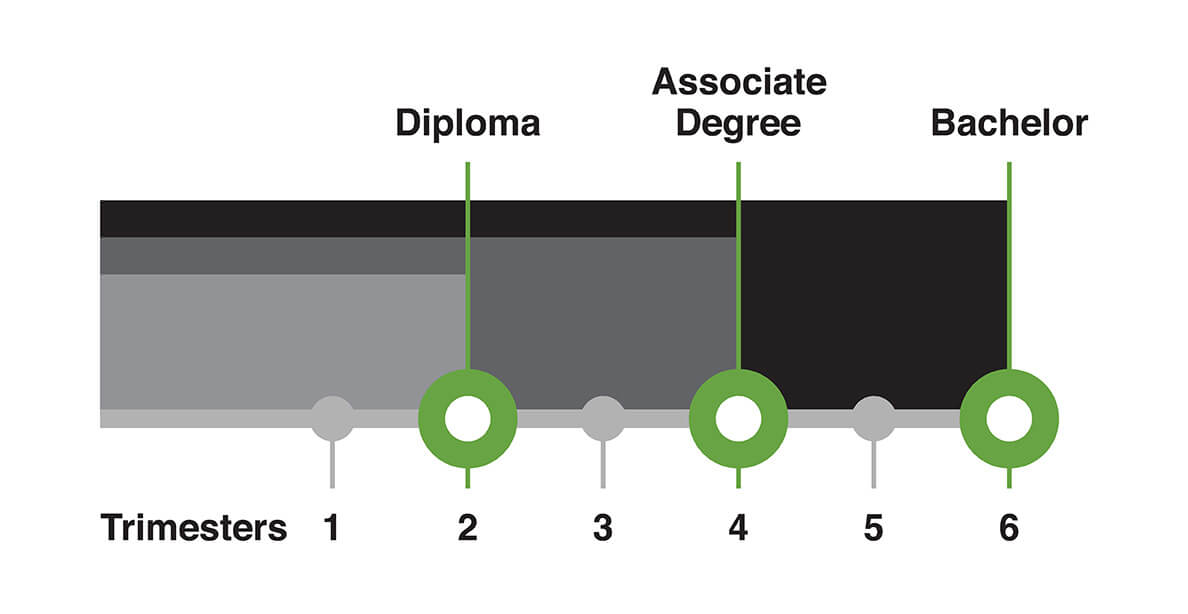
Welcome to Understanding Digital Production which will introduce you to fundamental digital theory and scholarship.
Here, you will explore the fundamental technical aspects of digital media files, colour theory, lighting theory, image types, resolution, aspect ratios, bit depth, frame rates, compression in addition to developing skills in Photoshop and digital matte painting. Additionally, you will explore foundational concepts of scholarship and theory through practical application.
The subject adopts a praxis learning approach, where theory meets practice. You will actively engage with digital media file concepts, colour theory, lighting theory and scholarship through targeted projects.
Introduction to Real-Time Engines will establish foundational knowledge for students. This unit includes the fundamental principles and workflows in real-time engines, in addition to the technical considerations. Students will explore a range of technical and theoretical concepts through a practical learning approach. In addition to developing their skills in using real-time engine software, students will develop their skills and knowledge from iterative development and reflection in order to embed foundational knowledge and skills. Additionally, students will build collaborative teamwork skills to establish professional practices and communication methods.
3D Asset Production introduces students to the planning, design and construction of 3D models using industry standard software and techniques. This unit introduces students to concepts of workflows and pipelines in order to develop 3D assets for a number of purposes for games, animation, VFX and real-time applications. Students will develop their understanding of theoretical concepts and the practical application of 3D modelling through a hands-on approach. By planning and creating a number of 3D assets, students will develop their skills in using industry standard 3D modelling software including Maya in addition to being introduced to Substance Painter.
This unit will cover a range of topics related to the acquisition and manipulation of images for use in film and visual effects, including colour management, image and asset acquisition, on-set and editorial theory, and the theory behind rendered and generated images, which are typically created using computer-generated imagery (CGI) software. Additionally, we will explore the technical aspects of project setup in Nuke, a powerful compositing software widely used in the industry.
Other topics that will be covered include matchmove, mattes and masks, common compositing tasks in Nuke, and project management. By the end of this class, students will have a solid understanding of the technical and theoretical aspects of image acquisition and compositing, as well as the skills needed to work with images in a professional setting.
This unit explores the concepts of entrepreneurship, innovation and project design. You will develop approaches to identify promising opportunities and actionable strategies to transform them into tangible successes. Through exposure to developing new ideas, processes and ways of working - both individually and in entrepreneurial teams - you will hone skills to put creative ideas into practice and achieve real-world impact.
As Alan Kay explained, "The best way to predict the future is to create it", so let's get at it!
This unit introduces you to the fundamental concepts and techniques of programming using a high- level programming language. You will learn to write, debug, and execute basic programs while developing problem-solving skills essential for computer science. The unit covers variables, data types, control structures, functions, data structures, file input/output (I/O), modules, error handling, and an introduction to object-oriented programming. By the end of the unit, you will be able to develop simple programs and understand core programming principles.
Worldbuilding for Virtual Environments is a practical unit focused on creating immersive digital worlds. Through hands-on projects, students learn to conceptualise, design, and implement virtual environments in a real-time engine. This unit provides essential skills for aspiring environment artists, virtual production artists, game artists and game designers.
Explore how lighting and camerawork are used to enhance storytelling across a range of digital production environments. You will be looking at how traditional filmmaking has influenced Game Cinematics and Virtual Production, and how Digital Cinematography is used to create innovative approaches to visual storytelling.
In this unit, you will collaborate on interdisciplinary projects that blend creativity and technology across fields such as film, audio, music, gaming, design, and computer science. Through project-based learning, you'll explore how different disciplines contribute to innovative outcomes—like immersive installations or interactive experiences. The unit focuses on strengthening communication, problem-solving, and teamwork across creative and technical areas. You'll be challenged to apply your existing skills while embracing new perspectives and ways of working, developing a holistic understanding of contemporary media production and preparing you to deliver complex, boundary-pushing creative solutions.
This class will cover various aspects of Procedural and Generative Systems, including the creation. You will learn about the different techniques used to create a range of Procedural and Generative graphics. Additionally, you will learn about rendering and real-time procedural graphics, which will help you understand how to make realistic graphics.
This class will provide you with a strong foundation in technical graphics, and you will be able to apply the techniques you learn to create realistic and believable shots and effects. You will also gain a deeper understanding of the Procedural and Generative process and be able to troubleshoot any issues that may arise.
Creatives have always contributed to real-world problem solving, whether through innovative inventions, creative calls for action, public awareness building, or art and science collaborations. In this unit you will use your interdisciplinary collaboration skills to address a real-world problem. Using different theoretical frameworks within a ‘hackathon’ style studio environment you will produce a prototype that can be presented within SAE, as well as to external stakeholders.
Virtual Production Pipelines builds upon previous units in 3D assets and real-time engines. This unit introduces students to virtual production pipelines, previsualisation, mocap and environments using real-time engines. Students will explore the theoretical concepts and practical application of virtual production pipelines and the technical and creative aspects required in professional settings. In this unit, students will explore real-time game engine capabilities and workflows by learning about virtual cameras, virtual lighting, virtual sets/environments, motion capture, camera tracking and how this applies to LED volumes and previsualisation. Through practical tasks and iteration, students will develop their understanding and skills through practical workshops and collaboration.
Welcome to Motion Capture which is a technology used in film/television, animation, games and interactive media. In this unit, you will be introduced to motion capture and its application for real-time and rendered contexts. You will explore the theoretical and practical aspects to mocap and gain hands-on experience to capture, export and edit mocap data. You will explore concepts of how mocap data can be applied to a number of applications including real-time engines. Students will require knowledge of and practical learning in using 3D software and real-time engines in order to undertake this unit.
Cinematography II will expand your knowledge in the areas of camera and lighting, which are essential skills required to have a career as a Director of Photography. The skills you learn in this unit can be applied to any form of film/TV production; short films, documentaries, music videos, TV commercials etc. You will learn to use technically advanced cameras, prime lenses and follow-focus units, as well as learn to shoot in LOG format (flatter colour space) and utilise LUTs (Look Up Tables) to enhance the look of your footage in colour grading. Lighting fixtures will be utilised in a variety of studio shooting scenarios, including day/night interiors and also green screen sequences. ND Filters will be explored in more detail, adding another creative tool to your filmmaking arsenal. Further focus will be placed on effective shot coverage and framing techniques in both drama and documentary settings.
This unit will build upon prior learning in VFX and compositing in addition to elements post-production techniques for VFX compositing. This unit will explore the theories and practices of VFX compositing and post-production techniques through practical application and theory. Students will gain a deeper understanding of the theories and principles of VFX in order to apply them in pragmatic ways. The skills and knowledge developed in this unit can be applied to many aspects of rendered and real-time applications. Students will additionally develop the considerations for capturing film footage and VFX renders for compositing.
This unit explores scripting and automation techniques, and their application in areas such as system administration and data extraction. You will learn to use scripting for automating tasks, managing system operations, and extracting data from the web. The unit also introduces the Internet of Things (IoT) and programming on microcontrollers. You will gain hands-on experience with sensors, actuators, IoT networking and communication, and basic security practices. The practical focus of this unit prepares you to design, implement, and manage automated and IoT systems effectively.
Welcome to Real-Time VFX where students will enhance and build more advanced skills in VFX using real-time engines and complimentary software. You will require prerequisite knowledge of lighting, shading, texture mapping and be proficient in using real-time engines such as Unreal Engine.
You will acquire skills and knowledge in real-time VFX using industry standard software such as Unreal Engine, including embedded tools like Niagara, and Houdini. You will explore a range of methods and techniques which are underpinned by theory that includes node-based logic, particle systems, simulations, scripts in addition to advanced textures and shaders. The potential uses for real-time VFX cover a wide range of possibilities in games, animation, film, previsualisation, virtual production and many other possibilities in training, health and science.
In this unit, we will start by discussing the principles of physics and mathematics that drive simulations, such as fluid dynamics, rigid body dynamics, and particle systems. You will learn how to use software such as Houdini, Maya, and Nuke to create realistic simulations of gravity, wind, fire, smoke, water, cloth, crowds, particles, and other natural phenomena.
In addition to simulations, we will also cover dynamic effects such as explosions, debris, and rigid body destruction. You will learn how to use tools such as Ftrack, Shotgun, and RV to manage and review your work.
Throughout the course, you will work on a series of practical projects that will give you hands-on experience in creating realistic simulations and dynamic effects. These projects will also give you an opportunity to showcase your skills to potential employers.
This unit will build upon prior learning in VFX and compositing in addition to elements post-production techniques for VFX compositing. This unit will explore the theories and practices of VFX compositing and post-production techniques through practical application and theory. Students will gain a deeper understanding of the theories and principles of VFX in order to apply them in pragmatic ways. The skills and knowledge developed in this unit can be applied to many aspects of rendered and real-time applications. Students will additionally develop the considerations for capturing film footage and VFX renders for compositing.
This unit develops students skills and knowledge of texturing and shading of 3D objects for a number of purposes including animation, games, VFX and a number of other applications. The techniques and processes covered in this unit will enable students to apply their theoretical knowledge to adapt to different contexts and purposes of texturing and shading. The file types, resolution, colour, transparency in addition to lighting concepts will be explored in more detail in addition to applied use of industry software such as Maya and Substance Painter.
Welcome to Real-Time VFX where students will enhance and build more advanced skills in VFX using real-time engines and complimentary software. You will require prerequisite knowledge of lighting, shading, texture mapping and be proficient in using real-time engines such as Unreal Engine.
You will acquire skills and knowledge in real-time VFX using industry standard software such as Unreal Engine, including embedded tools like Niagara, and Houdini. You will explore a range of methods and techniques which are underpinned by theory that includes node-based logic, particle systems, simulations, scripts in addition to advanced textures and shaders. The potential uses for real-time VFX cover a wide range of possibilities in games, animation, film, previsualisation, virtual production and many other possibilities in training, health and science.
This unit develops students skills and knowledge of texturing and shading of 3D objects for a number of purposes including animation, games, VFX and a number of other applications. The techniques and processes covered in this unit will enable students to apply their theoretical knowledge to adapt to different contexts and purposes of texturing and shading. The file types, resolution, colour, transparency in addition to lighting concepts will be explored in more detail in addition to applied use of industry software such as Maya and Substance Painter.
This unit will build upon prior learning in VFX and compositing in addition to elements post-production techniques for VFX compositing. This unit will explore the theories and practices of VFX compositing and post-production techniques through practical application and theory. Students will gain a deeper understanding of the theories and principles of VFX in order to apply them in pragmatic ways. The skills and knowledge developed in this unit can be applied to many aspects of rendered and real-time applications. Students will additionally develop the considerations for capturing film footage and VFX renders for compositing.
Learn using Industry Tools & Software









ASSOCIATE DEGREE OF VFX AND VIRTUAL PRODUCTION
Specially designed in consultation with industry experts from Technicolor and Ubisoft, SAE’s Associate Degree of VFX and Virtual Production will nurture your creativity, empower you to experiment, and enhance your technical skill set.
Comprising two of the three stages included in our bachelor’s program, our Associate Degree of VFX and Virtual Production explores core concepts, techniques and technologies including real-time engines, cinematography, compositing, world building, and 2D and 3D asset production.
In addition to your core units, you’ll explore dedicated electives to position yourself as an expert in your field. You can choose to specialise in one of three areas: Virtual Production, VFX, and Technical Art.
Guided by our industry experts, you’ll learn to apply theoretical knowledge and current best practices while utilising cutting-edge equipment such as virtual production studios, motion capture suits, high-end digital film cameras and green screens.
We’ll also equip you with critical employability skills including strategies for problem-solving, communication and self-promotion.
Upon completion, you will be eligible for up to 160 credit points towards the Bachelor of VFX and Virtual Production, providing a structured pathway to future study opportunities.
Start your journey towards an exciting career in VFX and Virtual Production today – enrol to study at SAE University College!




SAE University College has announced a new partnership with globally renowned design and visual effects studio FIN, placing the opportunity for students to get real-world industry experience through extended work placements at the centre of SAE’s VFX and Virtual Production course offerings.
Meet your VFX mentors
Meet your VFX mentors
Alex Adam - Film, Animation & VFX Lecturer
Alex brings 15 years of professional post-production and VFX experience to SAE, combining traditional fine art and filmmaking expertise with cutting-edge industry knowledge. His career spans multiple roles including Motion Designer, VFX Artist, Colourist, and Editor across post-production facilities along Australia’s east coast. Alex’s experience gives students the opportunity to learn from a professional actively working at the forefront of the industry.

Over 15 years of professional experience in post-production facilities as Motion Designer, VFX artist, Colourist, and Editor

Currently developing advanced virtual production projects and writing units for advanced post-production and compositing
Organises Queensland Screen Editors events on SAE Brisbane campus, connecting students directly with industry professionals
Meet your VFX mentors

Dr Scott Roberts – Course Director, Games & Technology
Dr Scott Roberts combines academic research excellence with practical industry experience in immersive design and interactive media. His expertise spans the intersection of technology and creativity, with particular focus on real-time engines, extended realities, and advanced 3D production pipelines. As both a researcher and practitioner, he brings cutting-edge knowledge of virtual environments and simulations to prepare students for the future of digital media.
PhD in Virtual Environments and Simulations with published research in international academic journals and book chapters
Developed interactive exhibitions for multiple national museums including Museums Victoria and WA Museum Boola Bardip
Member of IGEA and IGDA, Graduate of the Institute for Integrated and Intelligent Systems (IIIS)
CAREER OUTCOMES
- Virtual Set Builder/Environment Artist
- Virtual Camera Operator (VCO)
- 2D or 3D Modeler
- Texture Artist
- Graphics Programmer
- Storyboard Artist
- Virtual Production Supervisor
- VFX Assistant
WHAT OUR STUDENTS SAY ABOUT SAE


Aldo Arechar
SAE Alumni | Current Job: Hans Zimmer's Remote Control Productions company in LA

Keovilay Cola Saycocie
SAE Alumni | Current Job: Unreal Engine Developer

Sarah Khalaf
SAE Alumni | Current Job: TV ProducerSAE Associate of VFX and Virtual Production offers:

An opportunity to master your craft in the skills of professional VFX and virtual production, creating visually compelling and technically sophisticated computer graphics compositions.
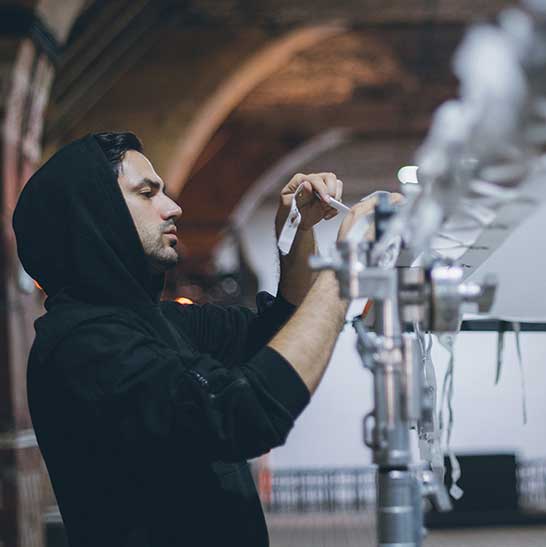
In-depth knowledge of the VFX and virtual production industry with practical, collaborative, industry-standard mentoring.

A range of approaches to learning and teaching, including virtual and on-campus opportunities that provide flexibility, application of knowledge to real-world projects, and ongoing support for students.
YOUR CAREER IN VFX AND VIRTUAL PRODUCTION BEGINS NOW
VFX AND VIRTUAL PRODUCTION SKILLS
FEE‑HELP* is an Australian Government loan scheme that assists eligible fee paying students pay all or part of their tuition fees. It cannot be used for additional study costs such as accommodation or text books. The total amount of FEE‑HELP a person can use is known as the ‘FEE‑HELP limit’.
Once a person begins using FEE‑HELP, the amount of FEE‑HELP they have left to use is known as their ‘FEE‑HELP balance’.
* Terms and conditions apply. For the latest updates regarding FEE-HELP please refer to sae.edu.au/fees
You can choose to study most of our courses in a part-time capacity. An SAE course advisor will be able to give you more information about the study options for your chosen course.
Note: Part-time is not available for international students.
CREDIT AND RECOGNITION OF PRIOR LEARNING
SAE may recognise your prior learning and may grant credit towards satisfying the requirements for a higher-level program. This is applied where previous learning is considered equivalent to the content and learning outcomes prescribed for units within the program.
For full details, please refer to SAE’s policy on recognition of prior learning and credit transfers.